
What Are “Trump Accounts” — And Should You Use Them for Your Kids?
A new type of investment account is set to roll out in 2026, and it’s already generated a lot of attention.
Often referred to as “Trump Accounts,” these are government-seeded investment accounts designed to give children a financial head start. On the surface, they sound simple—a $1,000 government contribution and a long-term investment account—but the real value depends on how they’re used.
Here’s what you need to know:
A Head Start from Day One
One of the most talked-about features is the $1,000 initial contribution from the federal government. While parents or guardians can set-up a Trump Account for any U.S. Citizen under 18, this $1,000 seeded contribution applies to children born between 2025 and 2028 and is automatically invested once the account is opened. The purpose is straightforward: to get money invested early so that it has decades to grow. If left untouched and invested properly, even that initial $1,000 could compound meaningfully over time.
How the Accounts Work
Trump Accounts function similarly to a traditional retirement account, but they’re designed specifically for minors:
- A parent or guardian opens and manages the account by submitting IRS Form 4547 or by using the online portal: https://form.trumpaccounts.gov/
- Contributions can be made by family members (and even employers) up to a $5,000 limit per year. Additional contributions may be available from other government entities and charitable organizations, which do not count towards the $5,000 contribution limit.
- The contributions are invested in low-cost stock index funds or ETFs of predominantly U.S.-based corporations
- The child gains control of the account the year they turn 18
Tax Treatment: The Key Trade-Off
From a tax perspective, these accounts fall somewhere in the middle compared to other accounts:
- Contributions are not tax-deductible
- Investments grow tax-deferred
- Later on, withdrawals are taxed as ordinary income
This is an important distinction. Unlike a Roth account, where growth can be tax-free, Trump Accounts defer taxes until withdrawal—meaning future tax rates will play a role in their effectiveness.
When Can the Money Be Used?
Generally, no withdrawals are allowed from these accounts during the “growth period” – basically, until the year the child turns 18. At age 18, the child gains control of the account and can begin using the funds.
The money can be used for:
- Education expenses
- A first home purchase
- Starting a business
- Or other financial needs
However, similar to retirement accounts, early withdrawals before 59.5 years of age may trigger income taxes and an early withdrawal penalty if not used for the purposes above.
This creates an interesting dynamic: while the account may be accessible earlier than a retirement account, it’s still best suited for long-term growth.
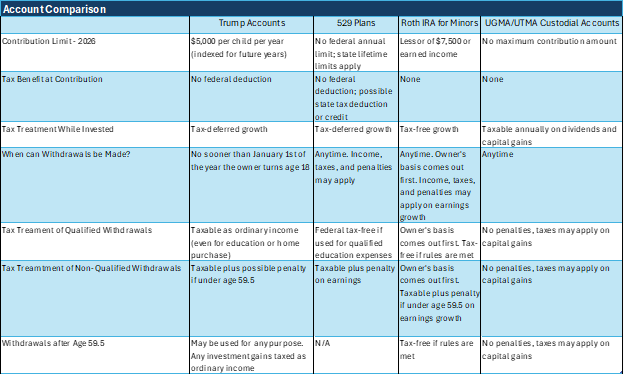
How Do Trump Accounts Compare to Other Options?
For many families, the key question is how Trump Accounts stack up against existing tools:
529 Plans:
- Better for education-specific goals
- Offer tax-free growth when used for qualified education expenses
- Less flexible than Trump Accounts
Roth IRAs (for kids with earned income):
- Offer tax-free growth and withdrawals
- Typically, more tax-efficient long-term
- Require earned income to contribute
Custodial (UTMA/UGMA) Accounts:
- Highly flexible
- No tax deferral advantages
- Can impact financial aid eligibility
As mentioned, Trump Accounts sit somewhere in between these existing options—more flexible than a 529, but less tax-efficient than a Roth IRA.
Where They May Add Value
For families, these accounts may make the most sense when:
- You want to start investing for a child early, even if that child doesn’t have earned income
- You value further flexibility beyond education planning
- You’re looking to supplement, not replace, other existing strategies
From our perspective, the greatest advantage may be behavioral: these accounts create a structured way for millions of children, who otherwise may not have had the access, to be able to invest from day one and experience the value of long-term capital appreciation first-hand.
Important Planning Considerations
While the concept is simple, the planning opportunities—and risks—are more nuanced:
- The account creates future taxable income, not tax-free wealth
- Long-term growth could lead to significant embedded gains by adulthood
- Coordination with other strategies (529 plans, Roth IRAs, gifting strategies) is key
Once the child turns 18, there is the ability to start converting the funds to a Roth IRA. This may be advantageous for younger earners who are still in relatively lower income tax bracket thresholds. As previously stated, contributions to Trump Accounts are generally made with after-tax/non-deductible contributions, so only the future investment gains would be taxable in the event of a conversion to a Roth IRA account.
The Bottom Line
For higher-income families especially, how this account fits into a broader financial plan matters more than the account itself.
Trump Accounts are best viewed as agovernment-seeded, long-term investment account designed to encourage early wealth building. Used thoughtfully, they can be a valuable addition to a broader plan. As with most financial tools, the real benefit comes not from the account itself, but from how it’s integrated into your overall strategy.


Leave a Reply